


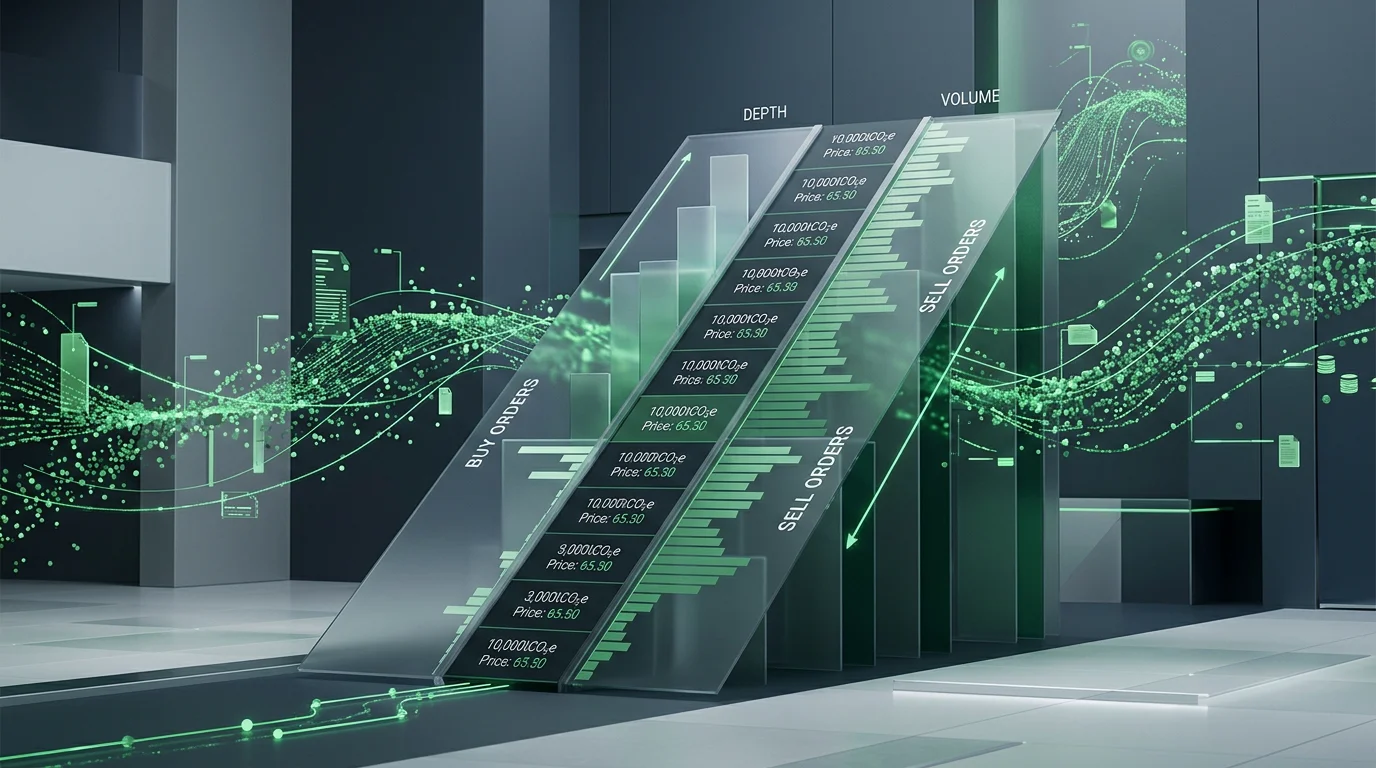

In 2025, EU carbon markets reached a valuation of roughly €777 billion, a scale that places allowances alongside major commodity classes. Yet size alone does not guarantee that a participant can trade quickly at a fair price. That capacity depends on the depth and fluidity of the carbon market, which determines whether a compliance buyer or an asset manager can execute without distorting the quote. To understand how allowances actually change hands, our guide to carbon market price discovery offers a useful starting point.
Liquidity is not an abstract metric. It governs execution costs, hedging efficiency, and the reliability of the price signal that guides low-carbon investment. According to ESMA data, investment firms and credit institutions accounted for around 62% of overall trading volumes in 2025, underlining how central financial participants have become to keeping the market moving.
What carbon market liquidity actually means
Consider a simple test: can you sell 10,000 allowances right now without pushing the price down against yourself? The answer defines liquidity. In practice, carbon market liquidity is assessed through a small cluster of metrics, including bid-ask spreads, total traded volume, open interest, and the depth of the order book. Narrow spreads and deep books signal a market where transactions absorb easily; wide spreads warn of thin conditions.
The EU Emissions Trading System is the reference case. It is the world's first carbon market and remains among the largest globally by trading volume and value. That maturity gives it structural advantages over younger schemes, where limited instruments and higher entry barriers keep activity shallow. Even within the EU ETS, however, liquidity is unevenly distributed across instruments and time horizons.
Why financial intermediaries supply the depth
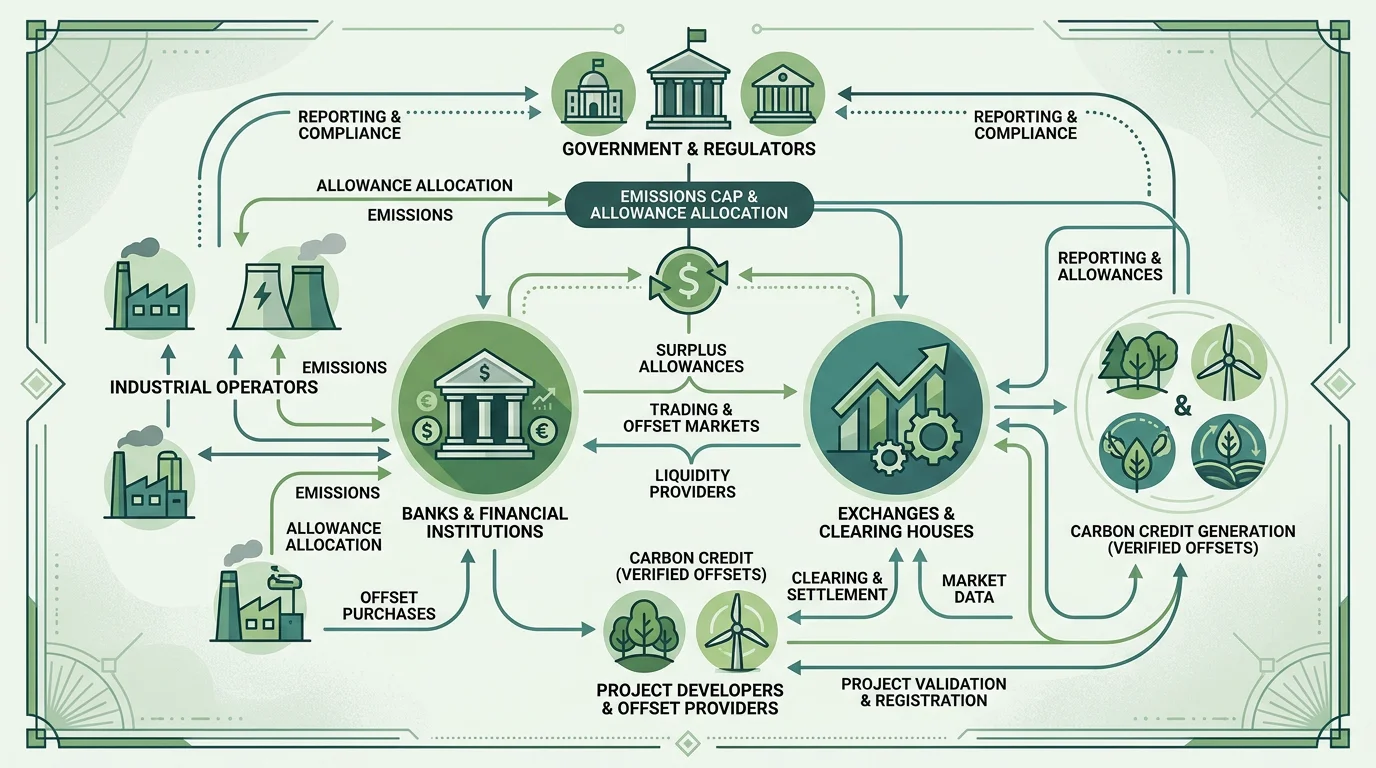
A striking feature of the EU carbon market is who provides its fluidity. Compliance entities, such as power producers and industrial operators, participate mainly to surrender allowances against their emissions. The continuous two-sided quoting that makes markets tradable comes largely from banks, investment firms, and brokers. These intermediaries provide liquidity, act as counterparties to non-financial firms, and help compliance operators access allowances and manage price risk.
This structure explains a recurring pattern in the auction segment, where a small group of participants buys the bulk of volumes and then redistributes allowances through secondary trading. For firms that need to reach this market efficiently, the choice of venue matters; our overview of ETS trading platforms explains how access routes differ. When you require faster execution and smaller trade sizes, an exchange designed around those needs can materially reduce friction.
Spot versus derivatives: a liquidity split
Not all corners of the carbon market trade with equal ease. The spot market for allowances tends to be thinner, constrained by a limited set of spot instruments and higher barriers to entry. Derivatives, by contrast, carry the majority of activity. The ESMA 2026 report notes that on-venue trading still accounted for almost 90% of secondary market activity, while over-the-counter volumes receded.
Within derivatives, short-dated futures concentrate the deepest liquidity, whereas long-dated contracts remain comparatively illiquid, a distribution common to most commodity derivative markets. The table below contrasts the main trading routes on the criteria that matter for execution.
| Trading route | Typical depth | Minimum trade size | Best suited for |
| Traditional exchange futures | High for short-dated | Standard lot of 1,000 EUAs | Institutional hedging |
| Over-the-counter (OTC) | Variable, receding | Negotiated, large | Bespoke bilateral deals |
| Spot market | Thinner | Varies | Immediate compliance needs |
| Our exchange platform (Initiativ) | Live, transparent pricing | From 1 EUA (1 tonne CO₂) | Granular access and automation |
The contrast is practical. Where a traditional exchange typically uses a standard lot of 1,000 allowances, a granular entry point lets smaller participants and precise hedgers engage without oversizing their positions.
How volatility and policy reshape trading conditions
Liquidity is not static; it tightens and loosens with the news cycle. In early 2026, allowance prices fell 29% over three months and volatility reached a two-year high, reflecting divergent expectations over future EU ETS rules, energy costs, and broader market conditions. Sharp moves of this kind widen spreads and can temporarily thin the order book, precisely when participants most need to trade.
Policy design sits at the heart of these dynamics. Scheduled allowance releases and the anticipation of them by compliance entities help sustain market liquidity and limit short-term price spikes. The 2026 revision of the ETS Directive and the mechanism that manages surplus supply are central to this. To understand how that surplus is absorbed, the EU ETS Market Stability Reserve (MSR) is worth examining in detail.
Practical steps to trade in a liquid, transparent way
How do you protect execution quality when depth fluctuates? Start by monitoring the metrics that reveal real conditions rather than headline prices alone. Watching bid-ask spreads and order book depth in real time tells you whether the market can absorb your intended size. Where live pricing is opaque, execution risk rises quietly.
Automation and pre-trade controls also matter. Configurable alerts let you react to price events without constant screen time, while pre-trade risk checks keep exposure within limits before an order reaches the market. When you need to integrate carbon trading into existing systems, our ETS access resources outline how API-enabled workflows support faster, repeatable execution across changing liquidity conditions.
Key takeaways on trading depth in the EU ETS
Ultimately, the liquidity of the carbon market is a function of structure, participants, and policy working together. Financial intermediaries supply most of the depth, derivatives carry the bulk of turnover, and spot trading remains comparatively shallow. For any participant, the practical priorities are consistent: monitor spreads and order book depth, size positions to real conditions, and choose venues that offer transparent, real-time pricing. As caps tighten and the ETS framework evolves through 2026, disciplined execution and reliable market access will matter more than ever.
Take action with Initiativ
Whether you manage compliance obligations under the EU ETS or trade allowances as a financial participant, execution quality depends on transparent pricing and dependable access. If you have felt constrained by large lot sizes or limited visibility on live prices, a purpose-built exchange can change how you engage with the market.
With our solutions for traders and corporates, you can trade EU Allowances from a single unit rather than a traditional 1,000-lot, monitor real-time prices, set configurable alerts, and apply pre-trade risk controls before execution. Cash is held in a segregated account with clearing support, and access is granted to members meeting KYC and KYB requirements. Request access to our demo environment to experience the platform first-hand.
Frequently Asked Questions
What is carbon market liquidity?
It is the ease with which emission allowances can be bought or sold without causing large price changes. Analysts assess it through bid-ask spreads, traded volume, open interest, and order book depth. Higher liquidity generally means lower execution costs and a more reliable price signal.
Why is the spot market less liquid than derivatives?
The spot segment offers a narrower range of instruments and carries higher entry barriers, which limits continuous trading. Derivatives, particularly short-dated futures, concentrate most activity because they support hedging and compliance planning. As a result, on-venue derivative trading dominates secondary market volumes.
Who provides liquidity in the EU ETS?
Banks, investment firms, and brokers supply most of the depth by quoting continuously and acting as counterparties. Compliance entities participate mainly to surrender allowances against their emissions. In 2025, investment firms and credit institutions represented around 62% of overall trading volumes.
How can smaller participants access the carbon market?
Traditional exchanges often require a standard lot of 1,000 allowances, which can exclude smaller or precise hedgers. Our exchange platform lets you trade from a single EUA, equivalent to one tonne of CO₂, with transparent live pricing. This granularity makes participation and precise position management more accessible.
How does policy affect trading conditions?
Regulatory design shapes both supply and confidence, which in turn influence depth and volatility. Scheduled allowance releases and mechanisms that manage surplus help sustain liquidity and limit short-term price spikes. The 2026 review of the ETS framework is a key factor watched closely by participants.
This may interest you



Let’s connect
Do you want more information about what we do?