




The broader carbon offsets market was valued at $1,364.25 billion in 2025 and is projected to reach $1,543.74 billion in 2026, according to Fortune Business Insights. Behind these numbers lies a surge of corporate net-zero pledges, tightening regulatory mandates, and a growing need for transparent infrastructure that connects buyers and sellers of verified emission reductions. For organizations operating under the EU Emissions Trading System or pursuing voluntary climate commitments, a platform for trading carbon offsets is no longer optional; it is a strategic requirement.
Yet not all platforms serve the same purpose, and the differences between compliance exchanges, voluntary marketplaces, and hybrid models can be difficult to navigate. Whether you are an industrial operator managing EU Allowances or a financial institution seeking programmable execution, understanding how these platforms work will help you make smarter decisions. Our guide to carbon trading platforms provides a foundational overview; this article goes deeper into the carbon offset trading platform landscape, covering market dynamics, platform types, evaluation criteria, and the regulatory forces shaping the sector in 2026.
What Is a Carbon Offset Trading Platform?
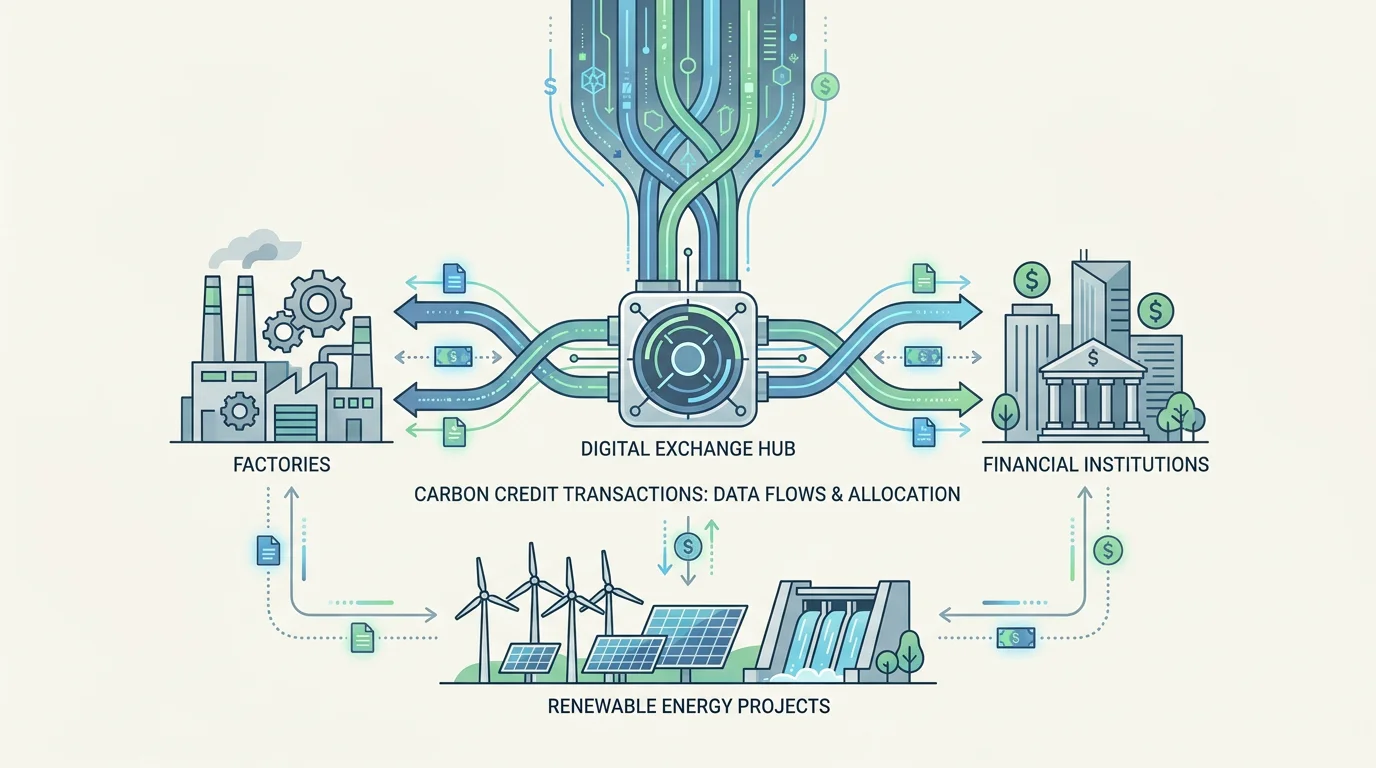
A carbon offset trading platform is a digital marketplace where organizations buy, sell, and manage carbon credits or allowances. Each credit typically represents one metric tonne of CO₂ equivalent that has been either removed from the atmosphere or prevented from being emitted. These platforms handle critical functions such as price discovery, transaction settlement, registry integration, and integrity verification.
Platforms vary widely in scope. Some focus exclusively on compliance markets (such as the EU ETS), while others serve the voluntary carbon market (VCM), where companies purchase offsets to meet self-imposed sustainability targets. A third category blends both, offering instruments across regulated and voluntary frameworks.
At the infrastructure level, modern platforms incorporate API access for automated trading, real-time pricing feeds, and pre-trade risk controls. These features matter because institutional participants, including banks, hedge funds, and asset managers, require the same execution speed and transparency they expect from traditional financial markets.
Market Size and Growth Trajectory
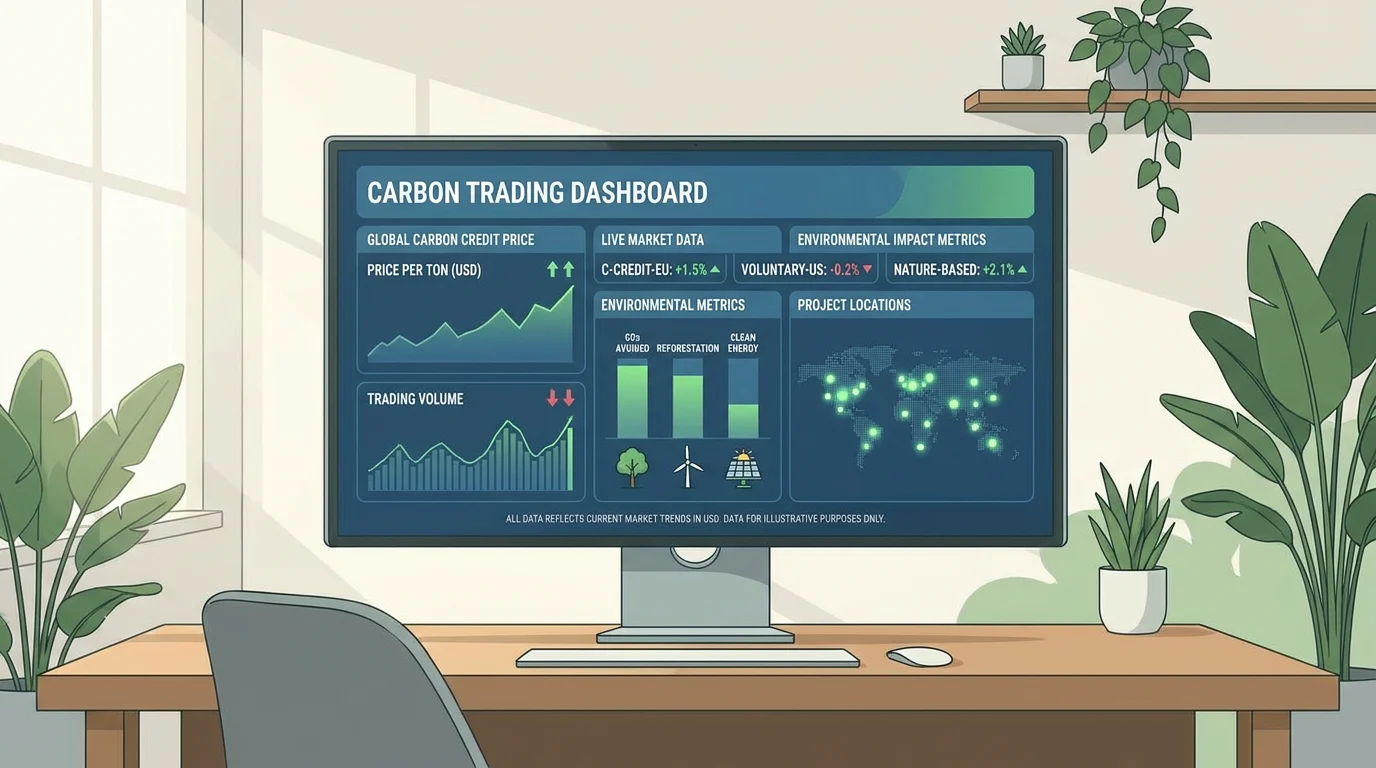
How large is the opportunity? The global carbon credit trading platform market is projected to grow from $235.50 million in 2026 to $1,272.11 million by 2034, at a CAGR of 23.47%, according to Fortune Business Insights. This trajectory reflects the expanding institutional appetite for digital carbon market infrastructure.
The voluntary segment is growing in parallel. The voluntary trading platform market is projected to grow from $1.15 billion in 2026 to $5.26 billion by 2034, exhibiting a CAGR of 20.8%, according to Intel Market Research. The market is experiencing rapid growth due to several factors, including surging corporate net-zero pledges, heightened ESG reporting requirements, and expanding high-quality project pipelines.
Major factors favoring adoption include regulatory mandates, corporate net-zero commitments, and the need for transparent, efficient carbon offset transactions. For participants in European markets, the EU ETS remains the largest compliance framework, and our resource on ETS trading platforms explains how to access it effectively.
Compliance vs. Voluntary: Two Distinct Platform Models
Before selecting a platform, it is essential to understand the fundamental distinction between compliance carbon markets and voluntary carbon markets. Each operates under different rules, serves different participants, and demands different platform capabilities.
Compliance markets are government-mandated systems, such as the EU ETS, where regulated entities must surrender allowances equivalent to their emissions. Trading here involves standardized instruments (EU Allowances, or EUAs) with strict regulatory oversight under frameworks like MiFID II. Platforms serving this space must offer clearing, custody, and audit trails that meet financial regulatory standards.
Voluntary markets, by contrast, allow organizations to purchase offsets from certified projects (verified by bodies like Verra or Gold Standard) to compensate for residual emissions. The compliance market segment held the largest market share, at 99.79% in 2026, according to Fortune Business Insights data, underscoring the dominance of regulated trading in overall market value. However, voluntary platforms are growing rapidly and play a critical role for organizations pursuing climate leadership beyond regulatory minimums.
For a deeper comparison, our article on voluntary credits vs emissions trading breaks down how these two mechanisms complement each other in a comprehensive climate strategy.
Key Features to Evaluate When Choosing a Platform
What separates a functional platform from one that truly serves your organization? The answer depends on your market segment, trading volume, and operational needs. The following criteria should guide your evaluation.
Execution Speed and Trade Flexibility
Institutional participants need sub-second execution and the ability to trade in flexible lot sizes. Traditional exchanges typically require a minimum of 1,000 EUAs per trade, which can be a barrier for smaller participants or those seeking precise position sizing. Platforms that allow trades from as little as 1 EUA open the market to a wider range of strategies.
Pricing Transparency
Opaque pricing erodes trust and increases transaction costs. The most effective platforms provide live, transparent pricing with configurable alerts, enabling participants to act on real-time market movements rather than rely on delayed quotes or broker intermediation.
API Access and Automation
Advanced platforms are integrating AI, IoT sensors, and satellite data for more accurate and automated processes. For professional trading desks, API-enabled automation is not a luxury; it is a necessity. Programmable interfaces allow firms to integrate carbon trading into existing risk management and portfolio systems seamlessly.
Regulatory Compliance and Custody
The rules and regulations governing carbon markets vary widely, and there is no uniformity in how carbon credits are calculated, verified, or treated across regions, making it complex for companies operating in multiple jurisdictions. Platforms must offer robust KYC/KYB onboarding, segregated custody accounts, and clearing partnerships to ensure regulatory compliance and asset security.
Comparing Leading Platform Approaches
The market includes several distinct platform models. The table below compares key approaches based on criteria that matter most to professional participants.
| Platform Approach | Market Focus | Minimum Trade Size | API Access | Pricing Model | Custody and Clearing |
|---|---|---|---|---|---|
| Initiativ (our exchange) | EU ETS (compliance) | 1 EUA | Yes | Transparent, real-time | Segregated accounts, FGDR guarantee up to 100k EUR |
| Compliance exchanges (traditional) | EU ETS, compliance | 1,000 EUAs | Varies | Exchange-based | Clearing via CCP |
| Voluntary spot exchanges | VCM | Varies | Varies | Order book / auction | Registry-based |
| Blockchain-based platforms | VCM (tokenized) | Fractional | Smart contracts | On-chain market rate | Wallet-based |
| OTC broker networks | Both | Negotiable | Limited | Bilateral negotiation | Counterparty-dependent |
For compliance-focused organizations operating in European markets, our exchange offers a distinctive combination: the ability to trade from 1 EUA with competitive fees, real-time price monitoring, and pre-trade risk controls designed for professional participants.
The Role of Regulation in Platform Selection
Regulation is not merely a compliance burden; it is the foundation of market integrity. In the EU, platforms facilitating the trade of emission allowances as financial instruments must operate under MiFID II. This means participant onboarding, transaction reporting, and best execution obligations are not optional enhancements but legal requirements.
Regulatory frameworks often require businesses to meet emission reduction targets or comply with cap-and-trade systems, creating a mandatory demand for carbon offsets as companies seek to fulfill their compliance obligations. The EU Carbon Removals and Carbon Farming Regulation (CRCF), currently under development, is expected to further shape how carbon credits are certified and traded across Europe.
For organizations navigating these evolving rules, understanding the routes to market in carbon emissions trading provides essential context on how regulatory structures influence platform choice, pricing, and counterparty risk.
Why Smaller Trade Sizes and Programmability Matter
One of the most significant barriers to broader market participation has been the standard lot size of 1,000 EUAs on traditional exchanges. At current EUA prices, this represents a substantial minimum commitment that excludes smaller compliance entities and limits the flexibility of larger participants seeking to fine-tune their positions.
Reducing the minimum trade to 1 EUA (equivalent to 1 tonne of CO₂) fundamentally changes who can participate and how. SMBs subject to the EU ETS gain direct market access without over-purchasing. Asset managers can construct more precise hedging strategies. Automated trading systems can execute in smaller increments, reducing slippage and improving risk-adjusted returns.
Combined with API-enabled programmable infrastructure, this flexibility allows carbon market participants to integrate trading directly into their existing workflows, whether that involves risk management platforms, treasury systems, or ESG reporting tools. We designed our programmable exchange specifically to address these needs, with longer trading hours and overnight yield capabilities that traditional venues do not provide.
Emerging Trends Shaping the Market in 2026
The carbon credit trading platform market is experiencing robust growth driven by increasing corporate commitments to net-zero emissions targets, with companies across sectors turning to carbon credits to offset residual emissions that are difficult to eliminate through direct reductions alone, while digital trading platforms provide the necessary infrastructure for transparent, efficient, and scalable transactions.
Several trends are defining the current landscape. First, institutionalization continues to accelerate. Institutionalization and liquidity growth in carbon credit trading platforms are key market trends. Banks, hedge funds, and asset managers are bringing financial market discipline to carbon trading, demanding the same execution quality and transparency they expect from equities or fixed income.
Second, regulatory convergence is slowly taking shape. While fragmentation remains a challenge, initiatives such as Article 6 of the Paris Agreement and the EU CRCF are creating clearer frameworks for cross-border credit recognition and quality standards.
Third, the integration of advanced technology, including AI-driven analytics, satellite-based monitoring, and blockchain verification, is improving credit integrity and reducing the risk of greenwashing. For environmental commodities trading platforms, these technologies are increasingly becoming table stakes rather than differentiators.
Choosing the Right Platform for Your Organization
The right platform depends on your specific context. Compliance entities subject to the EU ETS need a regulated exchange with clearing, custody, and MiFID II compliance. Voluntary market participants may prioritize project diversity and verification standards. Financial institutions require API access, flexible trade sizes, and integration with existing risk infrastructure.
Regardless of your profile, prioritize platforms that offer transparent pricing, robust security (including segregated accounts and clearing partnerships), and the regulatory standing to protect your interests. In a market projected to grow at over 20% annually through the end of the decade, choosing the right infrastructure now will determine your ability to capture value and manage risk as carbon markets mature.
For professional participants in the EU carbon market, our exchange provides a compelling foundation: trade from 1 EUA with transparent live pricing, configurable alerts, pre-trade risk controls, and API access, all within a regulated framework with FGDR-guaranteed cash protection up to 100,000 EUR. To explore how this works in practice, request access to our demo environment and experience the platform firsthand.
Frequently Asked Questions
What is the difference between a carbon offset platform and a carbon allowance exchange?
A carbon offset platform typically facilitates the buying and selling of voluntary carbon credits generated by emission reduction projects. A carbon allowance exchange handles regulated instruments such as EU Allowances (EUAs) under cap-and-trade systems. Some platforms, including our programmable exchange at Initiativ, focus specifically on compliance-grade allowance trading with institutional features.
How large is the carbon credit trading platform market in 2026?
According to Fortune Business Insights, the global carbon credit trading platform market is projected at $235.50 million in 2026, growing to $1,272.11 million by 2034 at a CAGR of 23.47%. The voluntary segment alone is projected at $1.15 billion in 2026, reflecting strong institutional demand.
Can smaller companies access carbon offset trading platforms?
Yes. While traditional exchanges require minimum lots of 1,000 EUAs, newer platforms have lowered the entry barrier significantly. Our exchange allows trades starting from just 1 EUA, making it accessible to SMBs, mid-market companies, and any professional participant seeking precise position management without excessive capital commitment.
This may interest you



Let’s connect
Do you want more information about what we do?